Welcome back to Nova Quant Lab.
In our relentless pursuit of quantitative alpha throughout Season 3, we have engineered a masterpiece. We forged a Data Refinery that streams real-time Order Book Imbalances (Post 10). We trained the lightning-fast logic of a LightGBM tree (Post 11) and the deep, sequential memory of an LSTM neural network (Post 13). Finally, we bound them together under the sovereign rule of a Meta-Labeling Ensemble Orchestrator (Post 14).
You now possess an apex predator of a trading system. But there is a final, terrifying question that separates the amateurs from the institutional quants: If you turn this machine on tomorrow with real capital, will it survive?
You cannot answer this question by simply looking at the training accuracy of your Machine Learning models. You must simulate the past with microscopic fidelity. However, the standard backtesting tools available to retail traders are fundamentally flawed when applied to High-Frequency Trading (HFT) and complex AI ensembles.
Today, in Post 15, we tear down the illusions of retail backtesting. We will expose the lethal flaws of “Vectorized” testing and architect the gold standard of institutional quantitative research: The Event-Driven Backtesting Engine.
1. The Lethal Illusion of Vectorized Backtesting
When a Python data scientist decides to backtest a trading strategy, they instinctively reach for the pandas library. They load a massive DataFrame of historical prices, calculate their signals across the entire column, shift the signal forward by one row using df.shift(1), and multiply it by the future returns.
For a slow, daily-moving-average strategy, this “Vectorized Backtest” is acceptable. For an AI-driven, tick-level arbitrage bot, it is a catastrophic hallucination.
Vectorized backtesting assumes a frictionless universe. It commits three fatal sins:
- The Assumption of Instant Liquidity: If your AI model signals a buy order for $500,000 of Bitcoin, a vectorized backtest assumes you get filled instantly at the exact closing price of that second. It ignores the reality that the order book might only have $50,000 available at that price, forcing you to sweep the book and suffer massive slippage.
- The Erasure of Latency: It assumes zero milliseconds between your AI generating a signal and the exchange executing it. In the real world, if your ensemble takes 20ms to calculate probabilities and the network packet takes 50ms to reach Binance, the price has already moved.
- The Look-Ahead Contagion: Because
pandasoperations are applied to the entire dataset simultaneously, it is incredibly easy for your Feature Engineering pipeline to accidentally peek into the future (e.g., standardizing a feature using the mean of the entire month rather than the rolling mean up to that exact microsecond).
To simulate a complex ML ensemble, we must destroy the DataFrame. We must rebuild time itself, tick by tick.
2. The Philosophy of the Event-Driven Engine
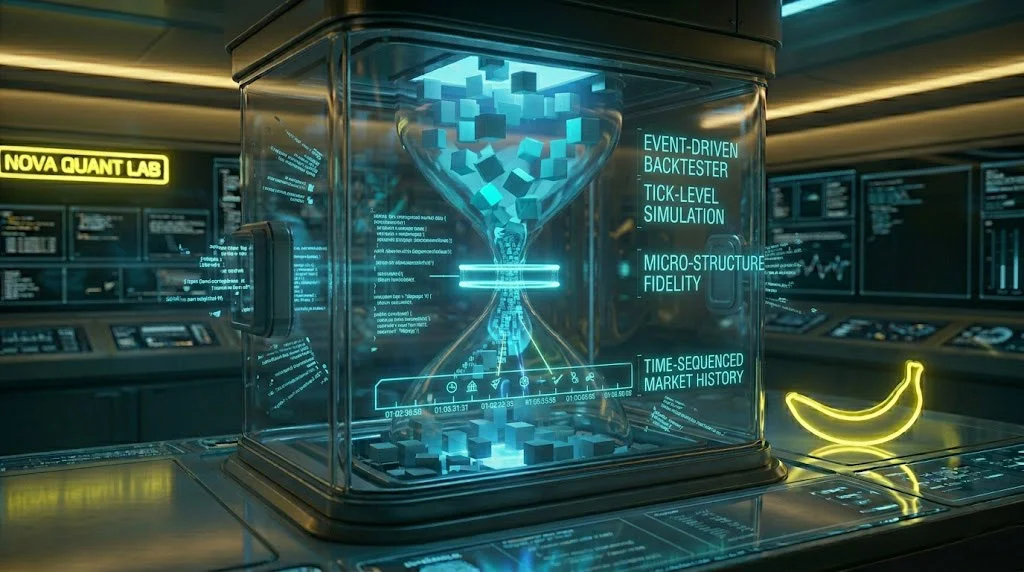
An Event-Driven Backtester does not calculate the past; it relives it. It is a software architecture built around an infinite while loop and a First-In-First-Out (FIFO) Queue. It mimics the exact physical infrastructure of a live cryptocurrency exchange.
In this architecture, time only moves forward when an Event occurs. There are four sacred Event Types in our system:
- Tick Event: A new row of historical Order Book data arrives.
- Signal Event: The AI Ensemble processes the Tick Event and generates a trading probability.
- Order Event: The Portfolio Manager receives the Signal, calculates the Kelly Criterion sizing, and sends a formal Order to the broker.
- Fill Event: The simulated exchange receives the Order Event, accounts for latency and slippage, and confirms the execution, updating our capital balance.
Because the system strictly processes these events one by one, it is mathematically impossible to peek into the future. The AI model only sees the data contained within the current Tick Event.
3. Simulating Market Micro-Structure: The Execution Handler
The true genius of an Event-Driven Backtester lies in its Execution Handler. This is the module that simulates the cruel realities of the exchange matching engine. If you lie to yourself here, your backtest is worthless.
Modeling Latency
When the Orchestrator fires an Order Event, the Execution Handler does not fill it immediately. It stamps the order with an artificially induced network delay.
If the historical order book at 10:00:00.000 triggered the signal, the Execution Handler suspends the order and waits until the simulation clock reaches 10:00:00.050 (a 50-millisecond delay). It then fills the order at whatever the price is at that specific, delayed millisecond. In highly volatile markets, this 50ms delay can turn a winning AI prediction into a losing trade.
Modeling Volume-Weighted Slippage
Your ML model might predict a spread convergence, but if you are trading significant capital, you must simulate market impact. The Execution Handler must look at the historical L2 Order Book depth at the exact moment of execution.
If you are buying 10 BTC, and the Best Ask only has 2 BTC resting, the Execution Handler must simulate sweeping through the next three levels of the order book, calculating your exact Volume-Weighted Average Price (VWAP).
Modeling Maker/Taker Fees
Delta-neutral arbitrage lives and dies by exchange fees. The Execution Handler must ruthlessly deduct 0.04% for every simulated Taker execution and accurately apply Maker rebates if your strategy utilizes Post-Only limit orders.
4. Engineering the Core Loop in Python
To build this in Python, we abandon pandas processing and rely on standard Object-Oriented Programming (OOP) and the built-in queue library. Below is the blueprint of the master SimulationEngine.
Python
import queue
import time

class SimulationEngine:
    def __init__(self, data_handler, ensemble_strategy, portfolio, execution_handler):
        """
        The Master Event Loop that orchestrates the simulation.
        """
        self.events_queue = queue.Queue()
        self.data_handler = data_handler
        self.strategy = ensemble_strategy
        self.portfolio = portfolio
        self.execution_handler = execution_handler
        self.is_running = True

    def run_simulation(self):
        """
        The infinite loop that processes events in chronological order.
        """
        print("Igniting Event-Driven Backtest...")

        while self.is_running:
            # 1. Fetch the next historical tick and place it in the queue
            if self.data_handler.continue_backtest():
                self.data_handler.update_latest_data(self.events_queue)
            else:
                self.is_running = False
                break

            # 2. Process all events currently in the queue
            while True:
                try:
                    event = self.events_queue.get(False)
                except queue.Empty:
                    break
                else:
                    # Route the event to the correct module based on its type
                    if event.type == 'TICK':
                        # Feed the new data to the AI Ensemble
                        self.strategy.calculate_signals(event, self.events_queue)

                    elif event.type == 'SIGNAL':
                        # Size the position based on ML probability
                        self.portfolio.update_signal(event, self.events_queue)

                    elif event.type == 'ORDER':
                        # Simulate latency, slippage, and exchange fees
                        self.execution_handler.execute_order(event, self.events_queue)

                    elif event.type == 'FILL':
                        # Update equity curve and log the exact execution price
                        self.portfolio.update_fill(event)
Notice the elegance of this architecture. The ensemble_strategy (which houses our LightGBM and LSTM models) knows absolutely nothing about portfolio sizing or exchange fees. It simply consumes TICK events and produces SIGNAL events. This strict separation of concerns allows us to plug our live trading API directly into this exact same framework later. The code you backtest is the exact code you deploy.
5. The Institutional Grading Rubric: Advanced Metrics
When the simulation completes, generating a final equity curve is not enough. A standard Sharpe Ratio can be manipulated by adjusting the risk-free rate or hiding tail-risk. To truly validate our AI Ensemble, we must evaluate it using institutional-grade metrics.
The Calmar Ratio
While the Sharpe Ratio penalizes all volatility, the Calmar Ratio specifically measures your strategy’s return relative to its worst-case scenario—the Maximum Drawdown (MDD).
Calmar_Ratio = [Annualized_Return] / [Maximum_Drawdown]
If your AI makes 50% a year but suffers a 40% drawdown during a market crash, your Calmar Ratio is 1.25. Institutional quants look for a Calmar Ratio greater than 3.0, indicating that the system’s risk-management overrides (our Meta-Labeling Vetoes) successfully protected capital during regime shifts.
Execution Shortfall
This is the ultimate test of your slippage and latency simulation. Execution Shortfall measures the difference between the “Paper Return” (what the AI predicted would happen at the mid-price) and the “Actual Return” (what the Execution Handler simulated after crossing the spread and paying fees).
Execution_Shortfall = [Paper_Return – Actual_Return] + Fees
If your ML model predicts a massive alpha, but your Execution Shortfall consumes 95% of that profit, your model is not trading alpha; it is trading noise. You must go back to Post 11 and adjust your LightGBM thresholds to only trigger on wider spreads that can survive the friction of the exchange.
Conclusion: The Final Baptism
We have built the ultimate proving ground. The Event-Driven Backtester is not just a tool; it is a philosophy of brutal honesty. By simulating the sequential flow of time, the delays of the network, and the friction of liquidity, we force our AI Ensemble to survive in a mathematically rigorous recreation of reality.
If your LightGBM, LSTM, and Z-Score Orchestrator can navigate this crucible, survive the simulated slippage, and produce a consistently upward-sloping equity curve with a high Calmar Ratio, you have achieved something truly extraordinary. You have built an institutional-grade quantitative system.
The infrastructure is built. The models are trained. The simulations are brutally honest and mathematically sound. There is nothing left to do in the laboratory.
In Post 16, the grand finale of Season 3, we will cross the final threshold. We will take this unified, event-driven, AI-powered ensemble and deploy it into the live cryptocurrency market. We will discuss the psychology of live deployment, the architecture of real-time monitoring, and the realization of fully autonomous yield generation.
The simulation ends. The reality begins.
Stay tuned for the grand finale in Post 16.