Welcome back to Nova Quant Lab.
You have reached the summit. This is the grand finale of Season 3, and the culmination of an architectural journey that has transformed you from a retail trader guessing at charts into a quantitative engineer commanding an army of algorithms.
In Season 1, we recognized the fatal flaws of human psychology. In Season 2, we built the rigid, unyielding infrastructure of delta-neutral statistical arbitrage. In Season 3, we gave that infrastructure a brain. We engineered order book features, trained LightGBM decision trees, harnessed the deep sequential memory of LSTMs, and unified them under a Meta-Labeling Ensemble Orchestrator. In Post 15, we subjected this AI brain to the brutal, unforgiving crucible of an Event-Driven Backtester.
If your Calmar Ratio is high and your simulated Execution Shortfall is low, the laboratory phase is officially over. It is time to cross the rubicon. It is time to deploy the AI into the live, adversarial ecosystem of the global cryptocurrency markets.
Today, in Post 16, we will seamlessly transition our simulation into reality. We will explore the institutional discipline of MLOps (Machine Learning Operations), learn how to mathematically monitor our AI for “Model Drift,” and discuss the ultimate psychological test: trusting the machine.
1. The Seamless Transition: From Simulation to Live Execution
The greatest architectural triumph of the Event-Driven Backtester we built in Post 15 is not its accuracy; it is its modularity.
In amateur retail bots, the backtesting code and the live trading code are two completely different scripts. This requires the developer to rewrite their trading logic for production, introducing catastrophic bugs and inconsistencies. The strategy tested is rarely the exact strategy deployed.
Because we built an Event-Driven Queue system, our transition to live trading requires zero changes to our AI Ensemble or our Signal Orchestrator. The core intelligence remains untouched. We simply swap out the peripheral modules.
- The Data Handler: In the backtester, this module read CSV files and emitted historical
TICKevents into the queue. For live deployment, we swap this with aLiveWebSocketHandler. It connects to Binance or Bybit viaccxt.pro, listens to the real-time L2 order book, and drops liveTICKevents into the exact same queue. - The Execution Handler: In the backtester, this simulated latency and slippage, emitting
FILLevents. For live deployment, we swap this with aLiveExecutionHandler. When it receives anORDERevent from the Ensemble, it sends a cryptographically signed REST API request to the exchange, waits for the real WebSocket confirmation, and drops a liveFILLevent into the queue.
The AI Ensemble sitting in the middle does not know—and does not care—whether the TICK events are coming from 2023 or from right now. It simply consumes data, calculates probabilities, and issues commands. This is the holy grail of quantitative engineering: absolute code parity between research and production.
2. MLOps and the Reality of Alpha Decay
When you press “Start” and your Python script goes live on your 24GB cloud server, you might feel a profound sense of relief. You might think the work is done.
It has only just begun.
Financial markets are not static physical systems; they are adaptive, adversarial ecosystems. When your AI finds a profitable edge (Alpha), it is extracting money from other market participants. Eventually, those participants will adapt, or other quantitative funds will discover the same Alpha and crowd the trade. This phenomenon is known as Alpha Decay.
Furthermore, Machine Learning models suffer from Model Drift. A LightGBM model trained on the volatility regime of a Bull Market will aggressively misinterpret the order book imbalances of a Bear Market. The statistical distribution of your features will shift, causing your model’s accuracy to silently bleed out.
Monitoring Concept Drift with KL Divergence
To operate a fully autonomous fund, you must build a real-time mathematical monitoring system. You cannot wait to lose $10,000 to realize your model is broken. You must measure the “distance” between the data your model was trained on and the data it is currently trading on.
The institutional standard for this is the Kullback-Leibler (KL) Divergence. It mathematically measures how much one probability distribution diverges from a second, expected probability distribution.
[ Formula: Kullback-Leibler (KL) Divergence ]
D_KL(P || Q) = Σ [ P(x) × log( P(x) / Q(x) ) ]
Where P(x) is the probability distribution of an engineered feature (like Order Book Imbalance) in your live trading environment, and Q(x) is the distribution of that exact same feature from your historical training dataset.
If the KL Divergence stays near zero, your live market regime matches your training regime. The AI is safe. If the KL Divergence spikes exponentially, it means the fundamental structure of the market has mutated. Your Live Execution Handler must have an automated Kill-Switch that listens to this KL Divergence metric. If the drift exceeds a critical threshold, the bot must autonomously halt all trading, flatten all open positions, and send an emergency alert requesting a full model retraining.
3. The Watchdog: Real-Time Telemetry and Alerting
A silent bot is a dangerous bot. If you have to log into your cloud server via SSH just to see if your AI is profitable today, your operational security is severely lacking.
A fully autonomous system must actively report its state to you. You are no longer a trader; you are the CEO, and the bot is your automated trading desk. It must provide you with real-time telemetry.
Using Python’s asynchronous capabilities, we integrate a Telegram Webhook Watchdog directly into the Event-Driven queue. The Watchdog listens to the FILL events and the SIGNAL events, broadcasting critical metrics directly to your phone:
- Execution Shortfall Alert: “Trade Executed. Expected Profit: 8bps. Actual Profit: 2bps. Slippage Warning: High latency detected on Bybit API.”
- Ensemble Veto Alert: “Z-Score triggered Short. Vetoed by LightGBM Meta-Model (Confidence: 0.12). Trap avoided.”
- Daily Summary: “Uptime: 24h. Trades Executed: 42. Win Rate: 58%. Daily Alpha Generated: +0.45%. KL Divergence: Normal.”
By streaming this telemetry to a dashboard (using tools like Grafana) or a private Telegram channel, you maintain absolute oversight of the machine’s heartbeat without ever needing to manually interfere with its logic.
4. The Psychology of Letting Go
We have spent three seasons building the ultimate quantitative machine. We have armored it with advanced mathematics, deep neural networks, and rigorous statistical validation.
Yet, the final point of failure is rarely the code. It is almost always the human architect.
When you deploy this system, you will eventually face a drawdown. Your AI will encounter a bizarre market anomaly, miscalculate the probability, and take a string of losses. It might lose 3, 4, or 5 trades in a row.
Your human instincts—the exact same evolutionary instincts we discussed in Season 1—will scream at you to SSH into the server and press CTRL+C. You will want to manually override the machine. You will want to “tweak” the LightGBM parameters on the fly just to stop the bleeding.
Do not touch the machine.
If you built your Event-Driven Backtester correctly in Post 15, you already know that a 5-trade losing streak is mathematically expected within your 99% Confidence Interval. You know that your ensemble’s edge plays out over 10,000 trades, not 5.
Interfering with a live, statistically validated AI during a calculated drawdown is the ultimate sin of quantitative trading. It destroys the integrity of your probabilities. You must learn to separate your emotional state from the intraday fluctuations of the equity curve. You must trust the Purged K-Fold validation. You must trust the math. You must let the machine learn, execute, and conquer.
Conclusion: Welcome to the Singularity
Take a moment to look back at where you started.
You began this journey staring at candlestick charts, drawing subjective lines on a screen, and fighting your own emotional biases.
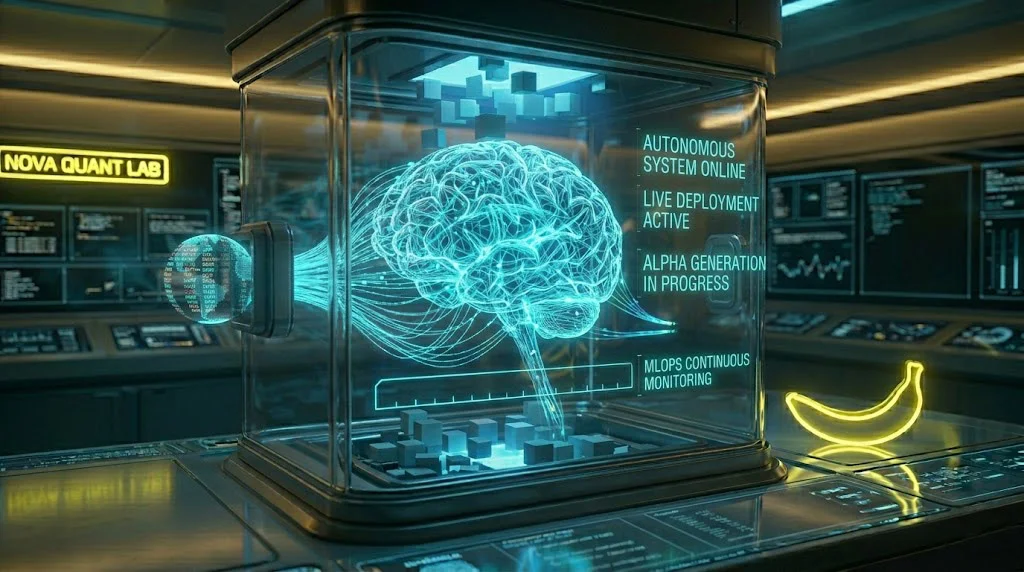
Today, you are operating a fully autonomous, event-driven quantitative system. Your 24GB cloud server is ingesting gigabytes of raw order book data. Your Python pipelines are engineering stationary features in microseconds. Your LightGBM and LSTM models are consulting each other, calculating probabilities in dimensions you cannot even visualize. Your execution handler is navigating the global liquidity pool, capturing mathematically guaranteed yield while you sleep.
You are no longer playing the game. You have engineered the player.
The Nova Quant Lab Season 3 is complete. The infrastructure is live. The singularity has been achieved.
The markets will change, the algorithms will evolve, and the alpha will constantly shift. But the framework you have built here—the uncompromising dedication to statistical truth, rigorous validation, and automated execution—will ensure you remain at the apex of the financial food chain forever.
Let the machine run.