
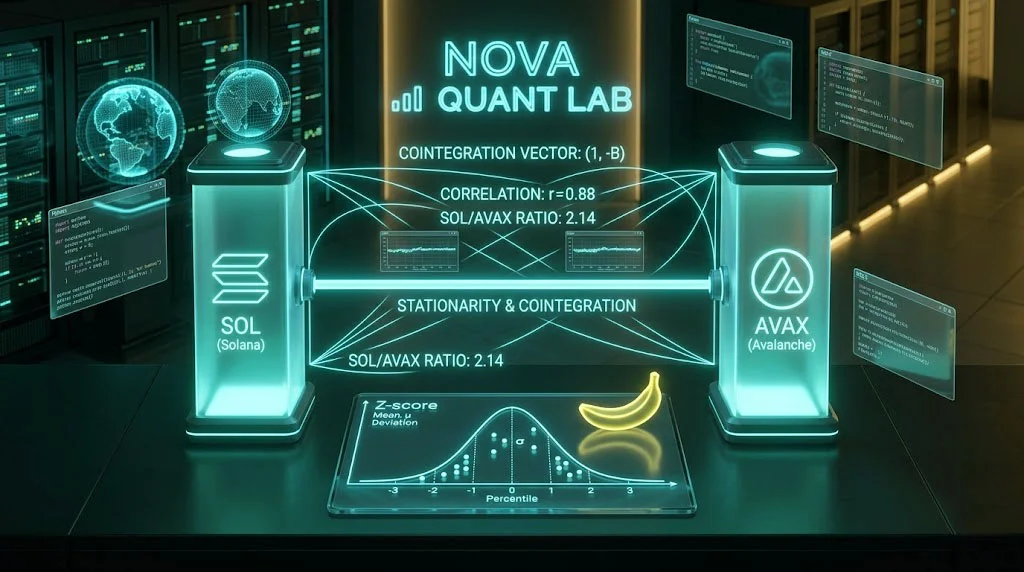
Welcome back to Nova Quant Lab.
We have traveled a vast distance in Season 2. We have moved from the raw infrastructure of 24GB cloud servers to the atomic execution of multi-leg orders across global exchanges. In Post 7, we explored the world of multi-asset portfolios and deterministic basis trading. But now, we are about to enter the most intellectually stimulating—and potentially most profitable—territory in the quantitative trading arsenal: Statistical Arbitrage (Stat-Arb).
To the uninitiated retail trader, the market looks like a chaotic sea of random walks. But to the quantitative scientist, the market is a highly structured ecosystem of hidden mathematical relationships. Today, we are going to look for the “ghost” in the data—the long-term, invisible equilibrium between two different assets that allows us to profit consistently, even when there is no direct “arbitrage” in the traditional sense.
We are moving beyond simple price tracking and into the elite mathematical world of Cointegration and Mean Reversion.
1. The Great Misunderstanding: Correlation vs. Cointegration
Every trader inherently understands correlation. If Bitcoin (BTC) experiences a massive bullish rally, Ethereum (ETH) usually follows. If the Nasdaq crashes, altcoins tend to bleed. However, in the strict discipline of quantitative finance, Correlation is a dangerously shallow metric.
Correlation simply measures how two assets move together over a specific period. It measures the direction, but it tells you absolutely nothing about the distance between them over the long term. For a market-neutral trader, relying on correlation is financial suicide. Two assets can be 99% correlated, but if they slowly drift apart over time—meaning Asset A goes up slightly faster than Asset B over a year—a “pairs trade” based on this correlation will lead to a catastrophic, slow-bleeding blowup.
This is where the concept of Cointegration becomes our primary weapon.
The Drunkard and His Dog Analogy
To visualize this, imagine a drunk man walking home from a bar, stumbling randomly from side to side down the street. His path is entirely unpredictable; in statistics, this is called a “Random Walk” or a non-stationary process. Now, imagine he is walking his dog. The dog also stumbles randomly, sniffing trees and chasing shadows.
If you look at the man and the dog as separate entities, they are both impossible to predict. However, because they are connected by a leash, there is a fundamental limit to their separation. They can never drift too far apart.
- Correlation is like two strangers walking in the exact same direction down the street. They might walk together for a block, but eventually, one takes a turn, and they are separated forever.
- Cointegration is the leash. Even if the man and the dog move in completely different directions for a brief moment, the mathematical tension of the leash eventually pulls them back together.
In Statistical Arbitrage, we are not looking for assets that simply move together. We are actively hunting for “Cointegrated Pairs”—two assets whose price difference (the spread) is Stationary. A stationary spread does not drift into infinity; it always returns to its historical mean. That predictable mean-reversion is our profit engine.
2. The Mathematical Proof: The Engle-Granger Two-Step Method
To trade cointegration, we cannot rely on “gut feeling” or visual chart patterns. We must prove that the relationship exists using rigorous statistical tests. The industry standard for identifying these relationships is the Engle-Granger Two-Step Method.
Step 1: Ordinary Least Squares (OLS) Regression
We begin with two candidate assets, for example, Solana (SOL) and Avalanche (AVAX). We cannot simply subtract the price of AVAX from SOL because they trade at entirely different price scales and volatilities. First, we must perform a linear regression to find the Hedge Ratio (β).
The Hedge Ratio tells us exactly how many units of Asset B we need to short for every one unit of Asset A we buy in order to remain perfectly market-neutral.
[ Formula 1: The OLS Regression & Hedge Ratio ]
Price_A = ( β × Price_B ) + Spread
Where β (Beta) is the Hedge Ratio, and the Spread is the residual error we will trade.
By running an OLS regression on historical price data, we extract the β multiplier and isolate the remaining “Spread”. This isolated spread is the actual tradable instrument. It is the leash.
Step 2: The Augmented Dickey-Fuller (ADF) Test
Once we have isolated the historical spread, we must prove beyond a reasonable doubt that it is a stationary time series. We apply the Augmented Dickey-Fuller (ADF) Test.
The ADF test checks the data for a “Unit Root.” If a time series has a unit root, it is a random walk (it can drift infinitely). If we run the ADF test on our spread and it returns a p-value lower than 0.05, we can scientifically reject the null hypothesis. We have mathematically proven that the spread is stationary. We have found a mathematically guaranteed leash.
3. The Velocity of Profit: The Half-Life of Mean Reversion
Finding a cointegrated pair is only half the battle. The next critical question for a quant is: “If I enter this trade today, how long will my capital be locked up before the spread returns to zero?”
Capital efficiency is everything in high-frequency trading. If a spread takes 6 months to mean-revert, the capital opportunity cost (and the accumulated exchange fees) will destroy the profitability of the trade. We need spreads that snap back quickly. To measure this, we calculate the Half-Life of Mean Reversion.
Based on the Ornstein-Uhlenbeck process, the half-life tells us the average amount of time it takes for the spread to revert halfway back to its historical mean.
[ Formula 2: Half-Life of Mean Reversion ]
Half-Life = −ln(2) ÷ λ
Where λ (Lambda) is the speed of mean reversion, calculated from regressing the spread against its lagged values.
If your Python Signal Orchestrator calculates a half-life of 2 days for the SOL/AVAX pair, it is a highly attractive target. If the half-life is 45 days, the Orchestrator should immediately discard the pair. We only want to deploy capital into highly elastic, fast-snapping statistical relationships.
4. Normalizing the Chaos: Trading the Z-Score
Because different pairs have different absolute spreads (a BTC/ETH spread looks vastly different numerically from a DOT/LINK spread), we cannot hardcode entry triggers based on raw price differences. We must normalize the spread using a Z-Score.
The Z-Score converts the raw spread into a standardized measure of standard deviations from the mean.
[ Formula 3: The Z-Score Normalization ]
Z-Score = ( Current_Spread − μ ) ÷ σ
Where μ (Mu) is the moving average of the spread, and σ (Sigma) is the standard deviation of the spread.
By standardizing our data into a Z-Score, our Python Execution Engine can apply universal trading rules across an entire universe of 50 different asset pairs:
- The Entry Signal: When the Z-Score hits +2.0 (or +2.5 for a more conservative strategy), it means the spread is unsustainably wide. Asset A is mathematically “overvalued” relative to Asset B. The Orchestrator fires an atomic order: Short Asset A and Long Asset B.
- The Sizing Logic: How much do we buy and sell? This is where our Hedge Ratio (β) from Step 1 comes in. If β = 0.5, and we buy $10,000 of Asset A, we must short exactly $5,000 of Asset B to remain neutral.
- The Exit Signal: We do not hold the position forever. When the Z-Score returns to 0.0, it means the leash has pulled the drunk man and the dog back to their equilibrium. The Orchestrator fires a concurrent close order, exiting both legs simultaneously and capturing the convergence as pure profit.
5. Risk Management: Surviving the “Structural Break”
Statistical Arbitrage is incredibly consistent, producing equity curves that look like a straight line moving up and to the right. However, it carries a specific, fatal risk: the Structural Break.
Remember the leash analogy? A structural break is the terrifying moment when the leash snaps. This occurs when the fundamental economic relationship between two assets changes permanently. For example, if Asset A suffers a catastrophic network hack, token hyperinflation, or a major regulatory lawsuit, it will crash violently, diverging from Asset B forever. It will never mean-revert.
If your bot relies purely on the Z-Score without a fail-safe, it will view this catastrophic crash as an “amazing buying opportunity.” As the Z-Score hits -3.0, -5.0, and -10.0, the bot will keep adding to the losing position until your entire account is liquidated.
The Quant’s Ultimate Shield: Time and Z-Score Stop-Losses
In directional retail trading, you set a stop-loss based on price. In Statistical Arbitrage, you set a Stop-Loss on the Model Itself.
Your Python infrastructure must include a strict Kill-Switch. If the Z-Score hits -4.0, or if the position has been open for 3 times the calculated Half-Life without reverting, the system must recognize that the cointegration model has failed. The leash is broken. The Orchestrator must immediately force-close both legs at a loss, accept the localized damage, and ban that specific pair from the trading universe until a new statistical relationship can be proven. You must never argue with a broken statistical model.
Conclusion: The End of the Beginning
Season 2 of Nova Quant Lab has been an intense, uncompromising journey into the absolute core of algorithmic trading. We started with the psychological realization that directional guessing is a loser’s game, transitioning into the philosophy of Delta-Neutrality. From there, we built an empire of code:
- Posts 1-3: We engineered the physical infrastructure—the asynchronous data ingestion, the atomic concurrent execution engine, and the leg-risk defenses.
- Posts 4-5: We built the logic and the fortress—the Net-Yield Signal Orchestrator and the optimized Linux production server.
- Posts 6-7: We scaled our vision—mastering performance analytics, Sharpe ratios, and multi-asset basis portfolio management.
- Post 8: We unlocked the final strategy—Statistical Arbitrage, Cointegration, and the mathematics of mean reversion.
The technical foundation of your quantitative trading firm is now complete. You have transitioned from a retail chart-reader into a quantitative architect. But the financial markets are a living, breathing, and constantly evolving adversary. Traditional statistical models are powerful, but they look exclusively at the past.
In the upcoming Season 3, we will venture into the final frontier of modern finance: Artificial Intelligence and Machine Learning (AI/ML) in Quant Trading. We will leave linear regression behind and learn how to use Deep Neural Networks, Random Forests, and Gradient Boosting algorithms to predict “Alpha” that simple statistics cannot see.
The machine is live. The statistics are robust. The yield is waiting.
Stay tuned for the grand opening of Season 3.