Welcome back to Nova Quant Lab.
We have officially crossed the technical rubicon. In our previous installments of Season 2, we moved with surgical precision to build the “High-Frequency Arbitrage Infrastructure.” We engineered the eyes to observe the market (Asynchronous Ingestion), the muscles to act (Execution Engine), the brain to strategize (Signal Orchestrator), and the fortress (Production Deployment). If you have followed the blueprint, your 24GB cloud server is now alive, humming with real-time WebSocket data and executing atomic, multi-leg trades without human intervention.
But for a professional quantitative trader, “it works” is just the starting line. The real question is: “How efficiently does it work, and how far can we scale it?”
In Post 6, we enter the Performance Phase. We are moving away from the “how-to” of coding and into the “why-it-matters” of alpha generation. We will learn how to interrogate our own trade logs to find hidden inefficiencies, how to measure risk in a delta-neutral context using advanced metrics, and how to architect a multi-exchange system that captures yield across the fragmented global liquidity pool.
1. Interrogating the Ghost in the Machine: Advanced Log Attribution Analysis
When your bot runs 24/7, it produces a mountain of textual data: the Execution Logs. Most amateur traders ignore these logs unless the bot crashes. To a quant, however, these logs are a goldmine of information. They contain the “DNA” of your slippage and latency.
The first step in performance optimization is Slippage Attribution Analysis. In Post 4, we built a Signal Orchestrator that calculates the “Net Yield” based on the order book. However, the market is adversarial. Your orchestrator might have calculated a 10bps (basis points) profit, but your logs might show that you only captured 7bps.
Where did the 3bps go?
By logging the exact timestamp in microseconds of the signal trigger and comparing it to the timestamp of the exchange’s fill confirmation, we can identify patterns of Network Jitter and Adversarial Lag. If the delay is inconsistent, we may need to optimize our Linux network stack further. If we are consistently getting “front-run” on specific price levels, it means our limit orders are too predictable. We must treat our logs not just as records, but as a feedback loop that informs our execution engine to adjust its safety buffers dynamically. We call this “Closing the Loop.” Every millisecond of latency identified in the logs is a potential increase in net profit once optimized.
2. The Mathematics of Neutrality: Redefining Performance Metrics
In directional trading, performance is often measured by simple “Return on Investment” (ROI). In quantitative arbitrage, ROI is a shallow metric. Because we are delta-neutral, our focus is on Consistency and Capital Efficiency.
The most important metric in our arsenal is the Sharpe Ratio. It measures the performance of an investment compared to a risk-free asset, after adjusting for its risk. For a delta-neutral bot, we focus on the stability of our equity curve.
[ Formula: Sharpe Ratio = (Portfolio Return – Risk-Free Rate) / Standard Deviation of Return ]
In a zero-delta context, our goal is a minimal standard deviation. Because we are hedged, our equity curve should look like a steady, upward-sloping line with very little “noise.” If your standard deviation is high, it indicates that your execution engine is suffering from significant leg risk or slippage, causing the “neutrality” to fluctuate. A professional arbitrage bot should aim for a Sharpe Ratio above 3.0. In the world of institutional quant funds, a Sharpe of 5.0 or higher is the target, as directional market risk is mathematically eliminated.
Furthermore, we must look at the Sortino Ratio. While the Sharpe Ratio penalizes all volatility (even the “good” kind), the Sortino Ratio only penalizes “downside” volatility. This is particularly relevant for arbitrage, where a sudden spike in the premium (upward volatility for our profit) is a positive event.
[ Formula: Sortino Ratio = (Portfolio Return – Target Daily Return) / Downside Deviation ]
A high Sortino Ratio indicates that our bot is effectively harvesting profit without suffering from catastrophic unhedged losses. In crypto, where “flash crashes” can cause temporary imbalances, the Sortino Ratio is often a more honest reflection of your bot’s true risk-adjusted health.
3. Horizontal Scaling: The Multi-Exchange Orchestration
Once your bot is consistently harvesting yield on a single exchange like Binance, you will eventually hit a ceiling: Liquidity Saturation. There is only so much “free money” available on a single exchange before your own orders start moving the market against you, eating into your net yield. To scale from a $10,000 account to a $1,000,000 account, you must move from a Single-Exchange model to a Multi-Exchange Orchestration.
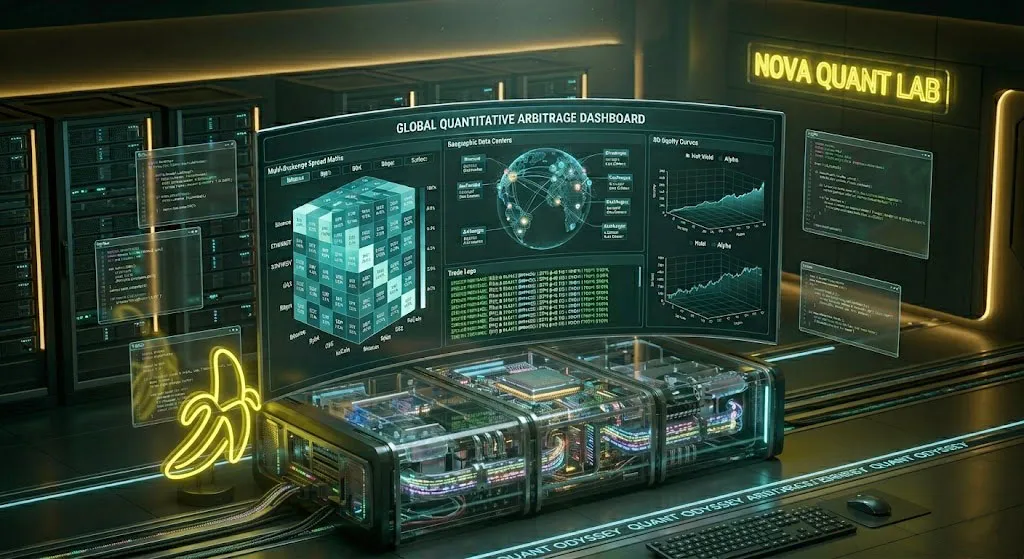
This introduces the Global Liquidity Aggregator. The next evolution of our Python infrastructure involves creating a class that monitors “Triangular Spreads” across multiple venues. For example, your bot might find a profitable spread by buying ETH on Binance Spot while simultaneously shorting the ETH Perpetual on Bybit and OKX.
This horizontal scaling introduces a new layer of complexity: Cross-Exchange Connectivity. Each exchange has its own API latency and matching engine logic. Your bot must now manage multiple ccxt.pro instances concurrently. The asyncio.gather() logic we built in Post 3 becomes even more critical here. You are no longer firing two orders; you are firing a “Cluster of Orders” across the globe.
You must also manage Fragmented Collateral. If the arbitrage opportunity is 90% on Binance but your funds are on Bybit, your capital is inefficiently distributed. A professional scaling strategy involves using a Portfolio Rebalancer that periodically moves USDT between exchanges using low-fee networks (like Arbitrum or TRC-20) to ensure your capital is always where the alpha is highest.
4. Advanced Yield Harvesting: Statistical Arbitrage and the Z-Score
In our early posts, we looked at the funding rate as a static yield. But the premium—the difference between the Spot price and the Futures price—is a dynamic, mean-reverting variable. If the historical average premium is 0.05%, but it suddenly spikes to 0.15% due to a retail long-squeeze, the Signal Orchestrator shouldn’t just enter the trade. It should recognize this as an Extreme Deviation.
By applying Z-Score analysis to the spread itself, we can drastically improve our entry timing. Instead of taking every 0.05% spread, we wait for the spread to hit a significant statistical deviation.
[ Formula: Z-Score = (Current Spread – Mean of Spread) / Standard Deviation of Spread ]
By only triggering our Execution Engine when the Z-Score is greater than 2 (indicating a deviation from the norm), we filter out the “noise” and focus only on high-probability, high-yield events. This “Statistical Arbitrage” approach allows us to capture not only the funding rate but also the capital appreciation as the spread reverts back to its mean. This transforms your bot from a simple fee-harvester into a sophisticated market-neutral predator. We are essentially betting on the “normalization” of market irrationality.
5. Dealing with Alpha Decay and the Need for Machine Learning
As we conclude this performance analysis phase, we must acknowledge the one constant in quantitative finance: Alpha Decay. Strategies that work today will eventually be crowded out as more bots enter the market and liquidity becomes more efficient. The “free lunch” gets smaller over time.
To stay ahead, the Nova Quant Lab must evolve into the frontier of Machine Learning-enhanced Signals. In the upcoming chapters, we will discuss how to use LightGBM or Transformer models to predict “Funding Rate Flips” before they happen, allowing our bot to exit a position before the yield turns negative. We are moving away from simple coding and into the era of Mathematical Optimization. We will explore how to train models on historical order book imbalances to predict price movement in the next 100 milliseconds—a technique known as “Alpha Generation through Order Flow.”
Conclusion: From Coder to Quant
You have successfully transitioned from a manual trader struggling with emotions to a quantitative architect managing a high-performance yield machine. You have the infrastructure, the risk management, and now the analytical framework to measure your success. The 24GB server you set up is no longer just a “computer”—it is a revenue-generating asset that operates on the fundamental inefficiencies of the global financial system.
In Post 7, we will dive into Advanced Spread Dynamics, looking at how to exploit the “Basis” across different settlement dates and how to manage a complex portfolio of 20+ different assets simultaneously. The machine is live. The logs are clear. Now, go and optimize.
Stay tuned for Post 7.