Category: Trading Automation
-
Beyond the Build: Performance Analytics and Multi-Exchange Scaling for Delta-Neutral Bots
Welcome back to Nova Quant Lab. We have officially crossed the technical rubicon. In our previous installments of Season 2, we moved with surgical precision to build the “High-Frequency Arbitrage Infrastructure.” We engineered the eyes to observe the market (Asynchronous Ingestion), the muscles to act (Execution Engine), the brain to strategize (Signal Orchestrator), and the…
-
The Fortress of Yield: Production Deployment and Kernel Optimization for High-Performance Quant Trading
Welcome back to Nova Quant Lab. We have arrived at the final technical milestone of our Season 2 infrastructure series. If you have been following our journey closely, you have successfully engineered a sophisticated piece of quantitative machinery. You have built the eyes to observe the market (Asynchronous Ingestion), the muscles to act (Execution Engine),…
-

The End of Directional Guessing: How to Build a “Risk-Free” Crypto Arbitrage Bot in Python
Welcome to Season 2 of Nova Quant Lab. In Season 1, we focused heavily on building the technical foundation. We covered Python environments, MT5 integration, setting up 24GB cloud servers, and connecting to global exchange APIs. We built the infrastructure. But I haven’t fully shared why I became so obsessed with algorithmic trading in the…
-
Monetizing Your Python Trading Algorithms: The Ultimate Guide to the MQL5 Market (2026)
Welcome to the pinnacle of Nova Quant Lab. Over our past 19 sessions, we have embarked on an extraordinary engineering journey. We started with basic API connections and scaled into a fully automated, asynchronous 5-node arbitrage fleet running 24/7 on a Linux Virtual Private Server. We secured our structural integrity with advanced fractional risk management…
-

Integrating Myfxbook API to Verify Your 5-Node Algorithmic Fleet and Trading Results (2026 Guide)
Welcome back to Nova Quant Lab. Over our last 17 sessions, we have engineered a highly sophisticated, fully automated quantitative trading infrastructure. We have deployed our Python algorithms on a 24/7 Virtual Private Server (VPS), implemented asynchronous multi-exchange arbitrage across five major global exchanges, and secured our structural integrity with dynamic Fractional Risk sizing and…
-

Multi-Exchange Arbitrage: Connecting Binance, Bybit, OKX, Bitget, and KuCoin via Python (2026 Advanced Guide)
Welcome back to Nova Quant Lab. Over our last 15 sessions, we have constructed a formidable, professional-grade quantitative trading infrastructure. We deployed our algorithms on a 24/7 Virtual Private Server (VPS), modularized our strategies to eliminate single points of failure, and bridged the gap between Python’s analytical processing power and institutional execution speeds. Now, we…
-
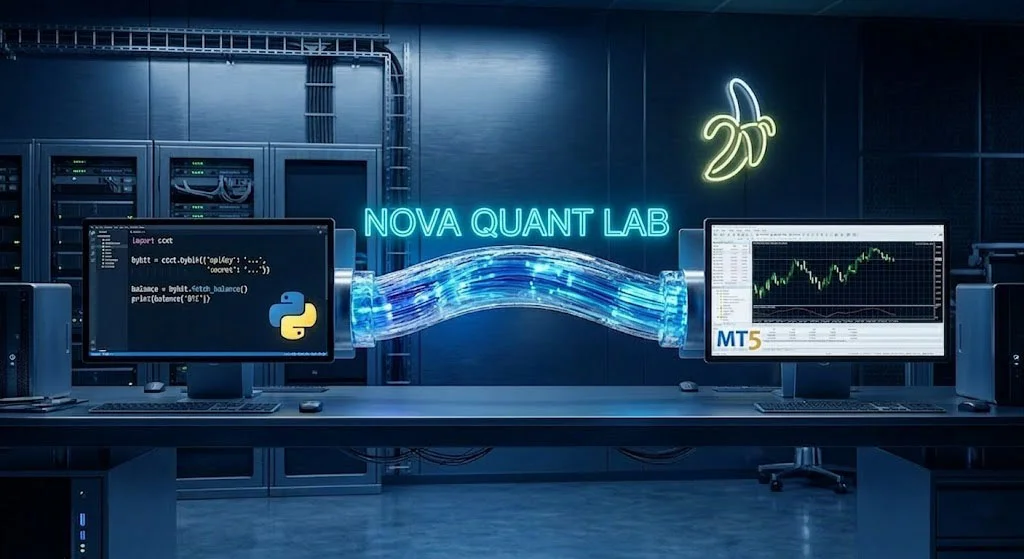
Python vs. MQL5: Bridging the Gap for Advanced Algorithmic Trading (2026 Guide)
Welcome back to Nova Quant Lab. Over our previous sessions, we have established a highly resilient, 24/7 automated trading infrastructure on a VPS. We have engineered Python algorithms to detect Fibonacci retracements and objectively quantify Elliott Wave momentum divergences. Our structural foundation is robust, and our analytical logic is precise. Up until this point, our…
-
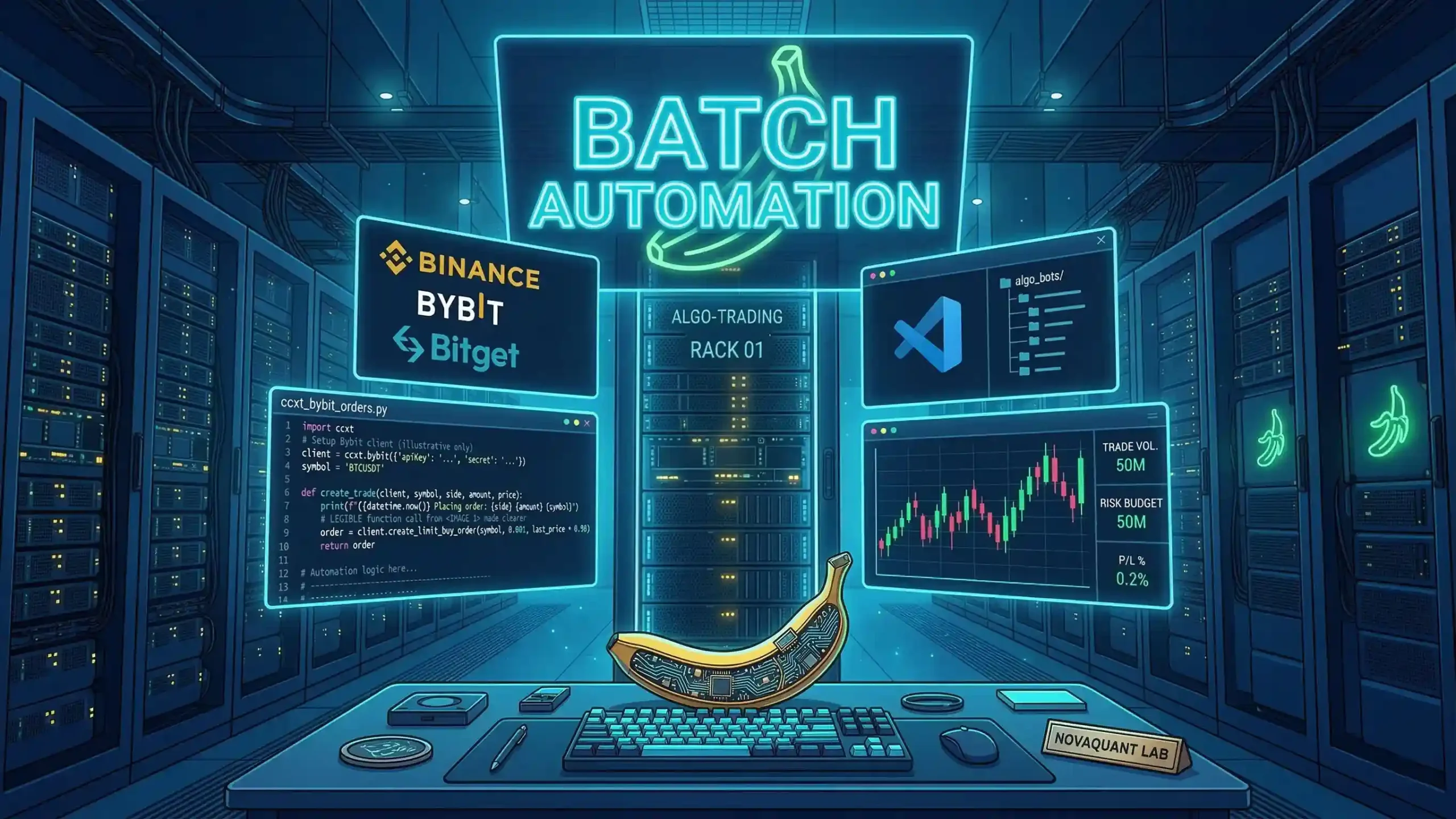
Managing Multiple Trading Bots: Automating VS Code Instances with Batch Files (2026 Guide)
Welcome back to Nova Quant Lab. In our previous session, we established the fundamental prerequisite for professional algorithmic trading: deploying your Python bots on a 24/7 Virtual Private Server (VPS). We successfully migrated our quantitative logic from a fragile local environment to a robust, redundant command center. However, as your quantitative journey progresses and your…
-
Building a Real-Time Notification System: Integrating Telegram Bots with Python Trading Algorithms
In the sophisticated world of Nova Quant Lab, we have spent considerable time conquering cloud deployment, statistical backtesting, and the psychological discipline required for automated execution. If you have followed our architectural blueprints, your Python trading bot is now a silent, relentless warrior. It executes complex mathematical logic in a remote, high-performance data center while…
-
The Ultimate 2026 Guide to VPS Deployment for Python Trading Bots
Welcome back to Nova Quant Lab, the premier destination for modern quantitative developers. Up until this point in our journey, we have focused extensively on the “brain” of our algorithmic operation. We have covered the strategy logic, data fetching protocols, rigorous backtesting frameworks, and the psychological discipline required to eliminate emotional bias from trading. However,…